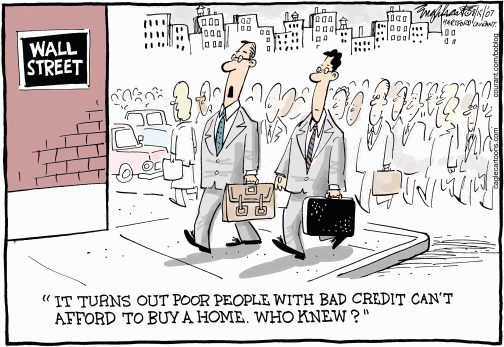
 (“The Liberal Curmudgeon,” n.d.)
As a result of the subprime lending fiasco, the federal banking regulators, in April 2007, issued a joint release encouraging financial institutions to seek out prudent working arrangements with troubled, subprime borrowers in a manner that is consistent with safe and sound lending practices (Brauneis & Stachowicz, 2007). The question has been how did this problem occur in the first place? However, the next step is how to address the situation and ensure that there is not a recurrence. Legislative and regulatory action has been a positive step to address the situation.
There have been several laws, rules, and regulations implemented in the interest of restricting banks from engaging in certain forms of activities and investments, chiefly proprietary activities (Schaefer, 2012). Many existing laws and regulations were not effectively enforced prior to the crisis. Some of the measures that have been implemented are as follows:
- The enactment of the Dodd-Frank financial reform of 2010, the Volcker Rule, was passed. The rule is intended to curb recklessness by barring banks from trading for their own gain, disconnected from client’s needs and demands (New York Times Editorial Board, 2013). It addresses a majority of the issues of the result of subprime lending and provides a strong assurance that a subprime crisis in the future may be avoided
- The Wall Street Reform and Consumer Protection Act was established in 2010, which provides assistance to homeowners’ upside down in their mortgage loans
- As an incentive, regulators indicated that financial institutions could possibly receive favorable Community Reinvestment Act (CRA) consideration for offering opportunities for low- to moderate-income customers to refinance higher-cost loans into lower-cost loans (Brauneis & Stachowicz, 2007)
- Banks and lending institutions increased loan qualifications standards and tightened mortgage loan qualification requirements, therefore making it harder to approve applications that indicated hardship in affording repayments on schedule
- The establishment of the Secure and Fair Enforcement for Mortgage Licensing Act of 2008 (SAFE Act), requiring nationwide licensing and registration for residential mortgage loans
- Fannie Mae and Freddie Mac stipulated that they would no longer purchase residential mortgage loans unless the loans complied with the Proposed Statement on Subprime Mortgage Lending (Taft, 2007)
Beyond the guidance issued by the banking agencies, there are additional practices that could assist in ensuring responsible subprime lending with regard to anti-predatory laws and regulations. These include ensuring borrowers repayment ability, provide home-ownership counseling, and ensuring the borrowers’ understanding of the terms and conditions of the loans. It is also encouraged that lenders go above and beyond the strict technical disclosure requirements of the Truth in Lending Act (TILA), Real Estate Settlement Procedures Act (RESPA) and similar statutes, considering the individual needs for customized disclosures tailored to each borrower in an effort to ensure that borrowers understand the unique terms, conditions and risks of the specific products offered (Brauneis & Stachowicz, 2007).
References:
Brauneis, M., & Stachowicz, S. (2007). Subprime mortgage lending: New and evolving risks, regulatory requirements. Bank Accounting & Finance (08943958), 20(6), 28-34. Retrieved from: http://eds.a.ebscohost.com.proxy1.ncu.edu/eds/pdfviewer/pdfviewer?sid=ddb0ce68-97ce-42fb-a960-df285b1e27e3%40sessionmgr4009&vid=1&hid=4111
New York Times Editorial Board. (2013). Finally, the Volcker Rule. New York Times. Retrieved from: http://www.nytimes.com/2013/12/13/opinion/finally-the-volcker-rule.html
Schaefer, S. (2012, April 19). Regulators: Banks have until July 2014 to comply with Volcker Rule we haven’t written yet. Forbes. Retrieved from: http://www.forbes.com/sites/steveschaefer/2012/04/19/regulators-banks-have-until-2014-to-conform-to-unwritten-volcker-rule/
Taft, J. (2007). The latest attempt to regulate subprime mortgage lending: The federal banking agencies issue the subprime mortgage lending guidance. Real Estate Finance, 24(3), 10-14.
The Liberal Curmudgeon: November 2011. (n.d.). Retrieved from http://www.theliberalcurmudgeon.com/2011_11_01_archive.html
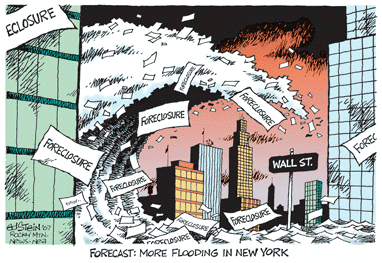 Courtesy of: USA Gold (2007).
 Kidd-Albright, K_MGT7019-8-6