Did leadership have a role in the decision making during the subprime loan financial crisis? This is a question that have been asked over and over. Thiel, Bagdasarov, Harkrider, Johnson, and Mumford (2012) in their research addressed the corporate and financial misconduct of the policy and decision-makers of the subprime crisis and discussed the role of ethical leadership. They speculated on how so much misconduct could have occurred when there are many policy and procedures put in place to protect against unethical practices. Thiel et al. (2012) suggests that the reliance on ethics solely in decision-making might be misplaced and insinuated that better decisions might be made using strategies for sensemaking. Thiel et al. (2012) defined sensemaking as the complex cognitive process engaged when one is faced with complex and high-risk situations.
In today’s society, ethical misconduct occurs because leaders do not possess the finest leadership characteristics. Ethical misconduct stems from complications that leaders have with accurately making sense of the business setting or other rational boundaries (Thiel et al., 2012). It is rather obvious that the subprime lending debacle which unveiled the financial crisis were complex and high-risk and required a mix of sensible and ethical reasoning to guide leaders in their decision making. We expect leaders to decipher problems and make excellent decisions while preserving ethical values with regard for the welfare of others and with an awareness to their social obligations which in many cases was not done (Thiel et al., 2012). Because of the lack of ethical decision making (EDM) being present in most cases, important factors of information were ignored during sensemaking which led to poor ethical decisions (Thiel et al., 2012).
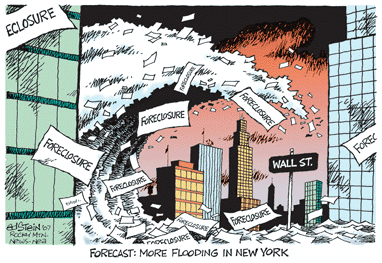 Courtesy of: USA Gold (2007).
The concept of social responsibility states that corporate activities should not only focus on generating profits, but also be concerned with social and ecological consequences (Elkington, 1998). Some would argue that by providing borrowers with subprime loans they were living up to their social responsibilities as these loans allowed many more to have the American dream (Gilbert, 2011). Banking is a peculiarly capitalist activity which focuses primarily on making a profit for its shareholders (Watkins, 2011). Interestingly, some banks have anticipated the adoption of these new rules by transforming their banking practices and adopting a more socially responsible financial attitude. This behavior not only includes the adoption of technical measures, but also a more general attitude of transparency and accountability, which ultimately manifests in other concrete actions (Paulet, Parnaudeau, Relano, 2015). However, they failed to go far enough to secure the American dream in perpetuity for the benefit of the public. Lenders also failed to realize that they had a socially responsible and moral duty not to approve loans that would likely cause harm to borrowers and others, which is what eventually transpired (Gilbert, 2011).
The social responsibility of the leaders of companies is to do what’s best for the greater good (Thiel et al., 2012). However, subprime lenders ignored the social good for the main purpose of maximizing profits at all cost. There was no code of social or ethical responsibility followed on the part of the leaders. The subprime loan was a source of income with no regard for the effect on the borrowers or society (Gilbert, 2011). Because of these choices, borrowers defaulted on home loans; banks and mortgage lenders foreclosed homes; home value prices dropped significantly; the whole investment banking industry, the largest insurance company, the largest mortgage lender, two of the largest commercial banks, two government institutions, and many of the largest subprime lenders closed shop, including Fremont, New Century, Ameriquest, and many, many more (Havermann, n.d.). The result, a very widespread financial crisis that affected other industries and the economy as a whole.
Had all involved exercised more social responsibility the big fallout from the subprime era which in essence led to the great recession, could have possibly been avoided.
References:
Elkinton, J. (1998). Cannibals with forks: The triple bottom line of 21st century business (2nd ed.). Capstone Publishing Ltd.
Gilbert, J. (2011). Moral duties in business and their societal impacts: The case of the subprime lending mess. Business & Society Review (00453609), 116(1), 87-107. doi:10.1111/j.1467-8594.2011.00378.x. Retrieved from: http://search.ebscohost.com/login.aspx?direct=true&db=bth&AN=59161773&site=ehost-live
Havermann, J. (n.d). The Crises Unfolds. Retrieved from http://www.britannica.com/topic/Financial-Crisis-of-2008-The-1484264/
Paulet, E., Parnaudeau, M., & Relano, F. (2015). Banking with ethics: Strategic moves and structural changes of the banking industry in the aftermath of the subprime mortgage crisis. Journal of Business Ethics, 131(1), 199-207. Retrieved from: http://eds.b.ebscohost.com.proxy1.ncu.edu/eds/pdfviewer/pdfviewer?sid=2794253b-add5-4965-999b-23f7d902449f%40sessionmgr106&vid=4&hid=120
Thiel, C., Bagdasarov, Z., Harkrider, L., Johnson, J., & Mumford, M. (2012). Leader ethical decision-making in organizations: Strategies for sensemaking. Journal of Business Ethics, 107(1), 49-64. doi:10.1007/s10551-012-1299-1
USA Gold. (2007). Top 25 quotes on the Credit Crisis of 2007. Retrieved from: https://www.google.com/url?sa=i&rct=j&q=&esrc=s&source=images&cd=&cad=rja&uact=8&ved=0ahUKEwiAi_27rezQAhXJwiYKHYjxDbAQjRwIBw&url=http%3A%2F%2Fwww.usagold.com%2Famk%2Fusagoldmarketupdate082707
Watkins, J. P. (2011). Banking ethics and the Goldman Rule. Journal Of Economic Issues (M.E.Sharpe Inc.), 45(2), 363-372. doi:10.2753/JEI0021-3624450213. Retrieved from: http://proxy1.ncu.edu/login?url=http://search.ebscohost.com/login.aspx?direct=true&db=bth&AN=60808385&site=ehost-live
 Kidd-Albright, K_MGT7019-8-6